Assignment Tracker Log Book KDP 8.5X11: A Practical, Production-Ready Resource for Self-Publishers
The Assignment Tracker Log Book KDP 8.5X11 is a purpose-built printable planner designed specifically for creators preparing interior files for Amazon Kindle Direct Publishing. Unlike generic notebooks or broad-spectrum planners, this resource addresses a narrow but frequently overlooked need: consistent, KDP-compliant tracking of assignments, deadlines, revisions, and project milestones—on paper, in a format that meets Amazon’s strict production requirements.
What It Is—and What It Isn’t
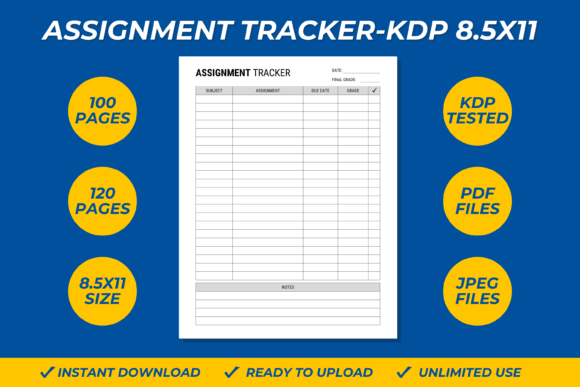
This isn’t a digital app, a subscription service, or a customizable template builder. It’s a static, ready-to-upload PDF interior file package—two versions (100 and 120 pages), both sized precisely at 8.5 x 11 inches, with no bleed, and fully pre-formatted to pass Amazon KDP’s automated checks. The first page includes a labeled space for the user’s name; the assignment tracker begins on page 3 and is laid out to work across left- and right-facing pages without disruption. There are no decorative flourishes, no extraneous graphics, and no hidden formatting traps—just clean, functional structure.
Why Format Compliance Matters More Than You Think
Many self-publishers underestimate how much time gets lost troubleshooting KDP upload errors: margin warnings, bleed misconfigurations, resolution flags, or page count mismatches. The Assignment Tracker Log Book KDP 8.5X11 eliminates those variables. Each PDF has been quality-checked against current KDP specifications—not just dimensionally, but structurally. That means:
- High-resolution output (300 DPI) suitable for crisp black-and-white printing;
- No bleed settings, aligning with KDP’s recommendation for text-heavy interiors;
- Consistent margins that avoid cutoffs during trimming;
- Page count options (100 and 120) that accommodate different planning depths without forcing unnecessary bulk or sacrificing usability.
In practice, this means users can upload either file directly—no reformatting, no trial-and-error PDF exports from design software, and no last-minute panic over “invalid interior” alerts.
Real-World Usability: How It Fits Into Actual Workflows
Freelance editors, course creators, and small-business consultants often juggle multiple client projects with overlapping deadlines. A digital task manager may handle reminders, but it doesn’t offer the tactile clarity of crossing off completed items or sketching quick notes beside an entry. The Assignment Tracker Log Book KDP 8.5X11 supports that hybrid approach: use it alongside digital calendars for high-level scheduling, then turn to the log book for granular, reflective tracking—e.g., noting revision feedback received on April 12, flagging follow-up items for May 3, or reviewing weekly progress trends by flipping back through prior pages.
Because the tracker starts on page 3 and the second page remains blank, users retain flexibility: they can add a title page, insert a brief instructions sheet, or even leave space for a printed cover mockup—all without disrupting the core functionality.
Design Strengths: Simplicity With Intention
The layout avoids over-engineering. There’s no complex color coding, no multi-tiered checkbox systems, and no rigid daily grids that become obsolete after three weeks. Instead, entries are structured around date, assignment name, status, due date, notes, and completion check—enough detail to stay useful, but not so much that filling it out feels like administrative overhead.
The inclusion of two JPG single-page previews (page 1 and the tracker spread) is a thoughtful touch. These aren’t marketing visuals—they’re functional references for verifying print alignment and checking how content renders before final upload. That level of attention signals experience with real-world KDP pain points, not just theoretical design.
Who Benefits Most—and When It Falls Short
This resource serves best those who:
- Prefer physical tracking but need KDP-ready deliverables;
- Produce multiple low- to mid-complexity print-on-demand planners annually;
- Want to minimize post-design QA time without sacrificing professionalism;
- Work with clients or teams who expect clean, standardized documentation.
It’s less suited for users needing heavy customization—like adding logos, changing fonts, or integrating branded headers. Since the files are static PDFs, not editable templates, modification requires design software and familiarity with KDP’s technical constraints. Likewise, educators building semester-long syllabi or researchers managing multi-year studies may find the 100–120 page range limiting if they require extensive archival space or cross-referencing features.
Long-Term Value and Practical Recommendations
Over time, the value of the Assignment Tracker Log Book KDP 8.5X11 compounds in consistency—not novelty. Because it’s built to KDP’s current spec, it remains usable across multiple publishing cycles without redesign. Users report reusing the same interior file for several tracker editions, updating only the cover and description. That reliability reduces cognitive load: once you know the format works, you stop questioning the tool and focus on the work itself.
For best results, pair it with a simple cover design that matches its utilitarian tone—clean typography, minimal color, clear title hierarchy. Avoid overloading the product description with vague claims like “life-changing” or “ultimate organizer.” Instead, highlight what matters to buyers: precise dimensions, KDP compatibility, and immediate usability. Realistic expectations lead to higher satisfaction ratings and fewer support requests.
A Final Note on Fit and Function
There’s no universal productivity tool—and the Assignment Tracker Log Book KDP 8.5X11 doesn’t pretend to be one. Its strength lies in doing one thing well: providing a dependable, specification-aligned interior for planners focused on assignment management. If your workflow involves frequent KDP uploads, values predictability over flash, and benefits from analog reflection alongside digital execution, this is a quietly effective asset—not because it’s flashy, but because it removes friction where it commonly appears.