Sustainable Seafood Cooking Kdp Planner: A Practical Design System for Food Creators and Small-Business Publishers
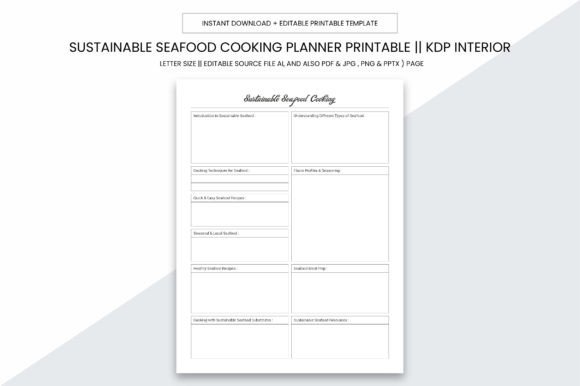
For chefs, home cooks, educators, sustainability advocates, and independent publishers, the intersection of culinary practice and environmental responsibility has never been more urgent—or more actionable. The Sustainable Seafood Cooking Kdp Planner emerges not as a static recipe book, but as a functional design system built for real-world implementation. It bridges intention with execution: helping users document sourcing decisions, track seasonal availability, align cooking methods with ecological impact, and prepare publishable content—all within a single, thoughtfully structured 109-page interior.
Why Structure Matters in Sustainable Food Communication
Knowledge about sustainable seafood—such as understanding MSC certification, identifying overfished species like Atlantic cod or Chilean sea bass, or recognizing regional alternatives like Pacific sardines or U.S.-farmed mussels—is only useful when it’s applied consistently. Yet many creators struggle to translate that knowledge into repeatable workflows. A PDF recipe collection may inspire once; a planner with intentional scaffolding supports daily decision-making. The Sustainable Seafood Cooking Kdp Planner is engineered around this principle: structure enables discipline, and discipline builds credibility.
This isn’t theoretical. Consider a culinary educator designing a workshop on low-impact seafood. With blank pages, they might jot notes haphazardly—losing context across sessions. With the planner’s preformatted sections—dedicated spreads for species profiles, supply chain notes, carbon footprint estimates per preparation method, and even vendor contact logs—they create a living reference that improves with each use. That same logic applies to a KDP author compiling a cookbook: consistent formatting, standardized yield calculations, and traceable sourcing statements become embedded in the process—not added as afterthoughts.
Design Integrity Meets Real-World Production Needs
The physical and digital specifications of the Sustainable Seafood Cooking Kdp Planner reflect deep attention to production realities—not just aesthetics. Its 8.5 x 11 inch size isn’t arbitrary. It matches standard U.S. letter paper and most commercial printers’ default trays, eliminating scaling errors or cropping surprises. The “no bleed” layout ensures margins remain intact whether printed at home, at a local print shop, or uploaded directly to Kindle Direct Publishing. That predictability saves time—and avoids costly reprints.
High-resolution output (300 ppi) guarantees crisp text and clean lines, critical when working with tables, checkboxes, or handwritten annotations. Unlike low-DPI templates that blur under magnification or fade when photocopied, this planner maintains legibility across formats and use cases—from a chef marking off ingredients mid-service to a researcher annotating mercury-level data alongside preparation notes.
Editable Source Files: Flexibility Without Compromise
One of the planner’s most distinctive features is its inclusion of editable source files—AI (Adobe Illustrator), PPTX (PowerPoint), and layered PNG/JPG assets—alongside the final PDF. This isn’t just convenience; it’s strategic adaptability. An educator can open the AI file and modify unit measurements from imperial to metric for an international audience. A small-business owner can replace placeholder vendor logos with their own branding before printing branded training materials. A KDP publisher can adjust font hierarchy or spacing to match their series’ visual identity—without redesigning from scratch.
Crucially, these files retain full typographic control, vector scalability, and color fidelity. You’re not editing flattened JPEGs or locked PDFs—you’re working with production-ready assets. That level of access transforms the planner from a passive tool into a collaborative foundation. It invites customization while preserving structural coherence—a rare balance in printable planning resources.
109 Pages of Purpose-Built Functionality
The interior’s length—109 pages—is neither arbitrary nor bloated. Each spread serves a documented need observed across food-system professionals:
- Species Reference Grids: One-page summaries for 32 commonly used species, including IUCN status, primary harvest method (e.g., pole-and-line vs. bottom trawl), typical habitat, and recommended cooking techniques aligned with texture and fat content.
- Seasonality Calendars: Regional U.S. and EU charts, color-coded by month, showing peak harvest windows—helping users avoid out-of-season imports and plan menus accordingly.
- Supply Chain Mapping Sheets: Visual flowcharts to log fishmonger contacts, delivery frequency, packaging type (e.g., vacuum-sealed vs. ice-packed), and traceability documentation received.
- Cooking Method Impact Logs: Side-by-side comparisons of energy use, water consumption, and byproduct generation for grilling, steaming, sous-vide, and pan-searing—paired with space to record actual observations from kitchen trials.
- KDP-Ready Layout Templates: Pre-formatted interior pages matching Amazon’s KDP requirements—including proper margins, bleed-free text blocks, and optimized line spacing for readability on both e-ink and digital screens.
Importantly, none of these sections are isolated. Cross-references are built in: a species profile page includes a field to note which seasonality chart it appears on; a cooking log links back to the corresponding supply chain entry. This interconnectedness mirrors how sustainability operates in practice—not as siloed facts, but as interdependent choices.
Use Cases Across Diverse Roles
The value of the Sustainable Seafood Cooking Kdp Planner reveals itself differently depending on who’s holding it—and why.
A researcher studying consumer behavior might use the vendor tracking sheets to correlate purchasing patterns with geographic proximity or certification visibility—then export anonymized data from the editable PPTX for presentation slides. A culinary instructor could assign students to complete the species impact logs as part of a module on life-cycle assessment, using the AI file to add institution-specific grading rubrics. A small-batch seafood processor might annotate the supply chain maps with cold-chain temperature logs, turning the planner into an internal compliance document.
Even hobbyists benefit meaningfully. Someone documenting their first attempt at smoking local mackerel doesn’t just get a blank journal—they receive prompts that guide reflection: “Was the skin crisp? Did brining time affect moisture retention? How does this compare to last month’s herring batch?” Over time, those entries build tacit expertise far more effectively than fragmented notes across apps or notebooks.
Commercial Utility Beyond the Kitchen
For business owners—especially those operating restaurants, meal-kit services, or specialty food stores—the planner functions as an operational asset. Its standardized logging reduces onboarding time for new staff: instead of memorizing verbal protocols, team members follow the same visual cues and terminology used across all planner pages. Inventory discrepancies become easier to trace when purchase date, supplier name, and species lot number are recorded in fixed fields—not buried in freeform text.
From a marketing standpoint, the planner supports authenticity. When a café posts a “This Week’s Sustainable Catch” board, the underlying data—verified through planner logs—can be shared transparently: “Today’s black cod is line-caught off Sitka, AK, verified via NOAA FishWatch. Cooked using steam-to-order to minimize energy use.” That specificity builds trust in ways generic claims cannot.
Integration Into Existing Workflows
Adoption succeeds when tools fit existing habits—not force new ones. The Sustainable Seafood Cooking Kdp Planner was designed for frictionless integration. Its PDF version works offline on tablets with stylus support (tested with Apple Pencil and Samsung S Pen). The editable AI file imports cleanly into Adobe Creative Cloud libraries, allowing designers to pull consistent color palettes or icons into other projects. Even the JPG/PNG assets are sized for direct use in social media carousels or email newsletters—no resizing or reformatting required.
No software subscriptions are needed to use it. There’s no login, no cloud sync, no algorithmic curation. It’s a tool you own—download once, print locally, edit freely, share without restrictions. That autonomy matters, especially for professionals managing sensitive supplier relationships or proprietary preparation methods.
Building Credibility Through Consistent Practice
In food systems work, expertise isn’t demonstrated solely through credentials—it’s proven through consistency. A chef who reliably sources Alaskan salmon during its August–October run, documents the change in flesh firmness across batches, adjusts marinade times accordingly, and shares those learnings with staff builds authority organically. The Sustainable Seafood Cooking Kdp Planner makes that consistency measurable, visible, and replicable.
It doesn’t claim to solve overfishing or climate-driven ocean acidification. What it does offer is clarity: a way to align daily action with long-term values, to turn abstract principles into concrete habits, and to transform personal practice into shareable, publishable, commercially viable knowledge. Whether you’re uploading your 109-page interior to KDP tomorrow or filling out your first species log this afternoon, the structure is already there—waiting to be filled with your experience, your judgment, and your voice.