Follower Tracker KDP Interior
If you're building a low- or no-content publishing business on Amazon KDP, the Follower Tracker KDP Interior isn’t just another template—it’s a quietly powerful tool designed for consistency, clarity, and real-world usability. This interior isn’t built around flashy visuals or experimental layouts. Instead, it’s grounded in purpose: helping creators, marketers, and small business owners track growth—page by page, month by month—with zero design overhead.
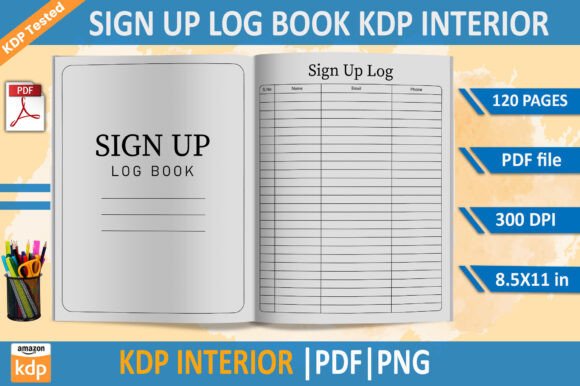
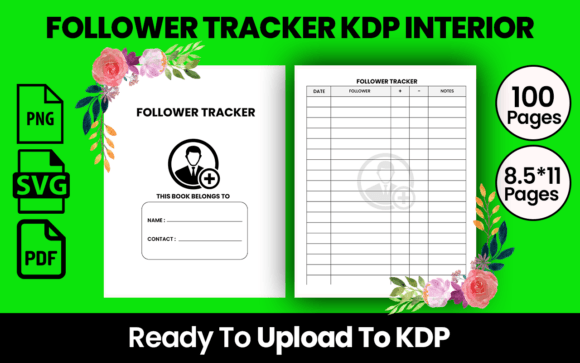
Visually, the Follower Tracker KDP Interior leans into clean, functional minimalism. The layout uses generous white space, consistent margins, and a restrained grid system that guides the eye without commanding attention. There are no decorative flourishes or distracting borders—just clear headings, subtle dividers, and thoughtfully spaced input fields. It feels professional because it *is* professional: tested across multiple KDP print runs, optimized for 8.5″ × 11″ trim size, and built with 300 PPI CMYK output in mind—no bleed, no guesswork.
Designed for Real Publishing Workflows
This isn’t a one-size-fits-all PDF you’ll need to tweak endlessly. The Follower Tracker KDP Interior ships with three ready-to-upload variants: 100-page, 110-page, and 120-page versions. Each is formatted precisely for KDP’s requirements—right down to gutter allowances and font embedding. You’ll also get high-resolution PNGs, editable AI files, and presentation-ready PPT slides—so whether you’re prepping a mockup for a client, updating your own tracker mid-campaign, or building a companion resource for a course, you’re covered.
Because it’s built from scratch—not repurposed from generic Canva templates—the interior maintains typographic integrity at every stage. Body text stays legible even after compression; heading hierarchy remains intact when scaled; alignment holds true across all 100 pages. That kind of reliability matters when you’re uploading dozens of titles per quarter and can’t afford rejected files or blurry previews.
Where This Interior Adds Quiet Value
You’ll reach for the Follower Tracker KDP Interior most often when speed and accuracy matter more than novelty. Think: launching a new Instagram analytics guide alongside your social media course. Or bundling a printable follower journal with your email newsletter as a lead magnet. Or creating a branded tracking workbook for coaching clients who want to visualize their audience growth over time.
It works especially well in contexts where users need structure—not inspiration. A content creator mapping podcast subscriber trends doesn’t need ornate calligraphy. They need columns labeled “Date,” “Platform,” “Followers,” and “Notes,” with enough room to write by hand or type cleanly. That’s exactly what this interior delivers: functional typography, balanced spacing, and predictable rhythm. No visual competition between elements—just calm, consistent utility.
Typography That Supports, Not Distracts
The type treatment inside the Follower Tracker KDP Interior follows modern editorial design principles: a neutral sans serif for body copy (optimized for both screen preview and physical readability), paired with a slightly bolder, more structured heading font for clear section breaks. Neither is a “creative font” in the decorative sense—there’s no script, no distressed texture, no exaggerated contrast. Instead, it’s a considered pairing that reinforces trust and competence.
That choice has real impact. In branding and publishing, readability isn’t just about font size—it’s about weight distribution, x-height, letter spacing, and how those variables interact across 100+ pages. A poorly spaced heading might vanish in KDP’s thumbnail preview. A font too light at 10 pt will blur during printing. This interior avoids those pitfalls entirely. Every character renders crisply at 300 PPI, every line height supports long-form scanning, and every margin allows for safe binding—even on thicker paper stocks.
Practical Tips Before You Upload
Before dropping any file into KDP, take five minutes to test it in context. Open the 110-page version in Adobe Acrobat and scroll through—not just the first ten pages, but pages 47, 83, and 109. Look for subtle shifts in alignment or spacing that sometimes creep in during PDF generation. Check how headers behave near page breaks. Verify that your chosen cover pairs visually: does the interior’s tone match the cover’s energy? A bold, colorful cover paired with this clean interior creates smart contrast—not mismatch.
Also, review the included AI file if you plan to customize. The layers are named and grouped logically (e.g., “Page Numbers,” “Input Fields,” “Section Headers”), so swapping out a logo or adjusting a header label takes seconds—not hours. And because all assets are delivered in CMYK, you won’t risk unexpected color shifts when printed. That’s not just convenience—it’s predictability baked into the workflow.
Why Consistency Beats Complexity
In a market flooded with “cute” trackers and overly themed planners, the Follower Tracker KDP Interior stands out by doing less—intentionally. Its strength lies in repetition done well: the same column widths across all 100 pages, identical spacing between rows, uniform indentation for sub-notes. That consistency reduces cognitive load for users. It also builds brand recognition—if you publish multiple KDP trackers using this interior, buyers begin to recognize your format as reliable, organized, and easy to use.
For designers and publishers, that kind of repeatable structure is gold. It means faster production cycles, fewer customer support questions about formatting, and higher perceived value—even at lower price points. When someone opens your follower tracker and immediately knows how to use it, that’s not luck. It’s intentional design language, applied consistently.
If you’re scaling a no-content catalog—or simply want one interior that handles growth tracking across platforms, audiences, and goals—the Follower Tracker KDP Interior fits like a well-worn notebook: unassuming at first glance, deeply useful over time. And since new design assets drop regularly on the profile, it’s worth keeping an eye on future releases—especially if you value clean, tested, print-ready tools over trend-chasing clutter.