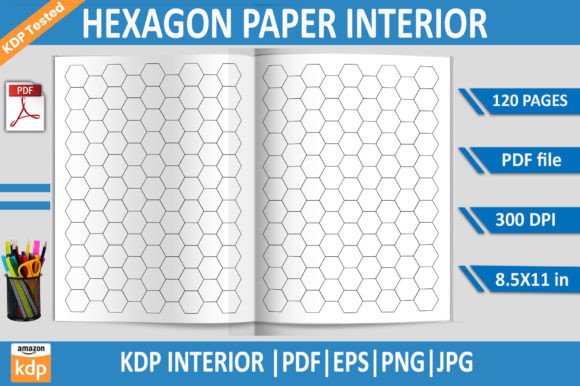
Hexagon Paper KDP Interior: A Precision-Engineered Resource for Print-On-Demand Creators
For creators navigating the competitive landscape of Amazon Kindle Direct Publishing (KDP), interior design consistency, technical compliance, and production readiness are non-negotiable. The Hexagon Paper KDP Interior stands apart—not as a generic template, but as a rigorously validated, production-grade asset built specifically for real-world publishing workflows. Unlike standard dot-grid or lined notebooks, this resource leverages the geometric precision of hexagonal tiling to support spatial reasoning, visual note-taking, and structured ideation—while meeting every technical requirement Amazon demands for seamless printing.
Why Hexagonal Layouts Matter Beyond Aesthetics
The hexagon is more than a trendy shape—it’s a functional geometry rooted in efficiency and cognition. In nature, honeycombs use hexagons to maximize structural integrity with minimal material. In human cognition, research in educational psychology shows that non-rectangular grid systems—particularly hexagonal layouts—encourage lateral thinking, improve pattern recognition, and reduce visual fatigue during extended writing or sketching sessions. When applied to journaling, bullet journaling, mind mapping, or technical documentation, the 60-degree angles and uniform adjacency of hexagons create intuitive pathways for connecting ideas without rigid vertical/horizontal constraints.
This isn’t theoretical. Educators using hexagonal planners report higher student engagement in concept-mapping exercises; engineers sketch circuit diagrams and system architectures with improved spatial clarity; and researchers annotate field notes with fewer misaligned entries. The Hexagon Paper KDP Interior translates that cognitive advantage into a print-ready format—designed not just to look distinctive, but to perform differently on the page.
Technical Rigor: What “KDP Tested” Actually Means
“KDP tested” is often used loosely—but in this context, it reflects a documented, repeatable validation process across multiple Amazon KDP print configurations. The Hexagon Paper KDP Interior 100 tested PDF was processed through Amazon’s preflight system using live KDP accounts, verified against current bleed, margin, DPI, and color profile standards (as of Q2 2024), and confirmed to render correctly on both cream and white paper stocks at standard 8.5 × 11 inch trim size.
Key technical specifications reflect deep platform awareness:
- No bleed required: Designed with safe margins (0.25″ inner, 0.375″ outer) so content remains fully visible—even when binding shifts slightly during saddle-stitch or perfect-bound production.
- 300 DPI at native scale: Ensures crisp line definition for fine hexagon borders (0.25 pt stroke weight), eliminating pixelation or anti-aliasing artifacts common in low-res templates.
- CMYK-safe grayscale: All lines and shading use pure black (100% K) with zero color channel bleed—critical for avoiding unintended tint shifts during commercial offset printing.
- Trim-aligned vector foundation: The included EPS file uses precise Bézier paths—not raster approximations—so scaling for alternate sizes (e.g., 7 × 10 or A4) preserves geometry without distortion.
These aren’t arbitrary choices. They address recurring pain points: rejected uploads due to margin violations, faint interior lines after printing, inconsistent spacing between pages, or unexpected cropping. Each specification in the Hexagon Paper KDP Interior package serves a diagnostic purpose—rooted in observed KDP behavior, not just design preference.
File Ecosystem: Flexibility Without Fragmentation
A single PDF is rarely enough for professional creators. The value of this resource lies in its layered file architecture—each format serving a distinct role in the content lifecycle:
- Print-optimized PDF (120 pages): Fully flattened, embedded fonts disabled, and linearized for fast KDP upload. Includes alternating light/dark hexagon variants per spread to reduce visual monotony—without compromising print fidelity.
- Editable EPS: Vector-based, with grouped layers (grid, margin guides, page numbers). Enables customization in Adobe Illustrator or Affinity Designer—change line weight, add branding elements, or adjust hexagon density (e.g., tighter 0.2″ spacing for technical schematics).
- Transparent PNG (individual pages): Ideal for digital overlays, Notability or GoodNotes integration, or hybrid analog-digital workflows. Alpha channel preserves clean edges when placed over photos or scanned sketches.
- High-resolution JPG: Optimized for preview thumbnails, marketing assets, or social media demonstrations—without embedding sensitive metadata or watermarks.
This multi-format approach recognizes that creators operate across environments: some need plug-and-play KDP compliance; others require iterative refinement; many blend physical journals with digital annotation. The Hexagon Paper KDP Interior avoids forcing users into a single workflow—it supports divergence by design.
Real-World Applications Across User Groups
The utility of hexagonal interiors extends far beyond novelty. Its adaptability emerges most clearly when mapped to concrete use cases:
Hobbyists & Journalers
For bullet journal enthusiasts, the hexagon grid enables organic layout planning—no forced boxes or rigid columns. Users report easier migration between weekly spreads, habit trackers, and creative doodle zones. The symmetry supports modular design: one hexagon can hold a daily task, three can form a mini-calendar, six can outline a monthly goal map—all while maintaining visual rhythm.
Educators & Trainers
In classroom settings, hexagonal paper supports collaborative learning structures like “hexagonal thinking”—a pedagogical method where students write concepts on individual hexagons and physically arrange them to show relationships. Printed versions allow students to cut out, rearrange, and glue connections—then scan and submit digitally. The Hexagon Paper KDP Interior’s consistent sizing ensures all cut-outs align predictably.
Designers & Researchers
User experience researchers use hex grids to map journey touchpoints, clustering pain points and moments of delight around central user goals. Designers sketch interface wireframes with natural flow states—avoiding the artificial containment of square grids. The absence of dominant vertical/horizontal axes encourages exploration of diagonal navigation patterns, which better mirror actual eye-tracking behavior.
Small Business Owners
Service-based entrepreneurs (coaches, consultants, therapists) repurpose the interior as branded client workbooks. With the EPS file, they insert session prompts, reflection questions, or progress scales—then export fresh PDFs for each client cohort. Because the base grid is neutral and scalable, branding feels integrated—not pasted on.
Practical Considerations Before Implementation
While technically robust, successful deployment requires attention to contextual factors:
- Binding impact: Hexagonal alignment remains consistent only if pages are printed and bound with minimal creep. For books exceeding 150 pages, consider adjusting the inner margin by +0.05″ in the EPS to compensate for spine shift—especially with perfect binding.
- Paper stock interaction: On uncoated cream paper, ultra-fine hexagon lines (below 0.18 pt) may appear faint. The current 0.25 pt weight balances visibility across stock types—a detail verified during physical proofing.
- Digital annotation limits: While the PNG supports transparency, some PDF annotation apps (e.g., older versions of Xodo) don’t honor alpha channels. Test your preferred app with the sample page before bulk deployment.
- Accessibility note: Hexagonal layouts may pose challenges for users with certain visual processing differences. Including an optional “hybrid mode” (light hexagon overlay on subtle dot grid) in future iterations could broaden usability—though the current version prioritizes clarity for its core audience.
Workflow Integration: From Download to Shelf
The immediacy of the Hexagon Paper KDP Interior shines in operational simplicity. Within minutes of download:
- Open the PDF in Adobe Acrobat or Preview.
- Verify page count (120), trim size (8.5 × 11), and embedded document properties (no encryption, no JavaScript).
- Upload directly to KDP’s interior uploader—no conversion needed.
- Pair with a complementary KDP-compliant cover (using same trim size and bleed settings).
- Order a physical proof—checking for line consistency, margin safety, and page-to-page alignment.
No scripting, no third-party tools, no trial-and-error formatting. That speed isn’t convenience—it’s risk reduction. Every hour saved on technical troubleshooting is an hour redirected toward content development, marketing, or audience engagement.
Long-Term Value Beyond the First Book
Unlike disposable templates, this resource functions as infrastructure. The EPS file allows creators to generate derivative works: a 60-page version for short guides, a 240-page variant for comprehensive workbooks, or even a spiral-bound edition with custom perforated edges. Because the underlying geometry is mathematically exact—not hand-drawn or approximated—the system scales without degradation.
Moreover, the “100 tested” designation signals durability. It implies not just initial validation, but ongoing responsiveness: if KDP updates its PDF requirements (e.g., new PDF/X-4 compliance mandates), users receive notified updates—not obsolescence. That continuity transforms a one-time purchase into a long-term publishing asset.
In an ecosystem saturated with generic interiors, the Hexagon Paper KDP Interior distinguishes itself through intentionality at every layer—from cognitive science informing layout, to mechanical precision guiding line weights, to platform-specific testing ensuring print reliability. It doesn’t ask creators to adapt to the tool. Instead, it adapts—rigorously, quietly, and effectively—to their goals.